Headline return
+21,846 USD +873.84% on T7 ChimeraTradingView scripts · Futures systems · Classical Charting
One TV scripts path, performance-first proof.
Table7.ai is built around TradingView script access, transparent scorecards, and a clear route from interest to tools. Futures flagships include the 15m T7 Chimera and 1m T7 Scalper, with Titan, Titan 2, Atlas, and the Hydra series on Micro Bitcoin and the S&P. Classical Charting adds stock strategy/indicator alerts and the web-hosted T7 Social Desk under that same TV scripts story as the lane opens. NinjaTrader delivery stays available separately for supported futures systems — not bundled as Classical desk access.
- TradingView access for active subscribers
- Classical alerts + web Social Desk included with Table 7 TV scripts
- Futures scorecards with measured risk; NinjaTrader separate for supported systems
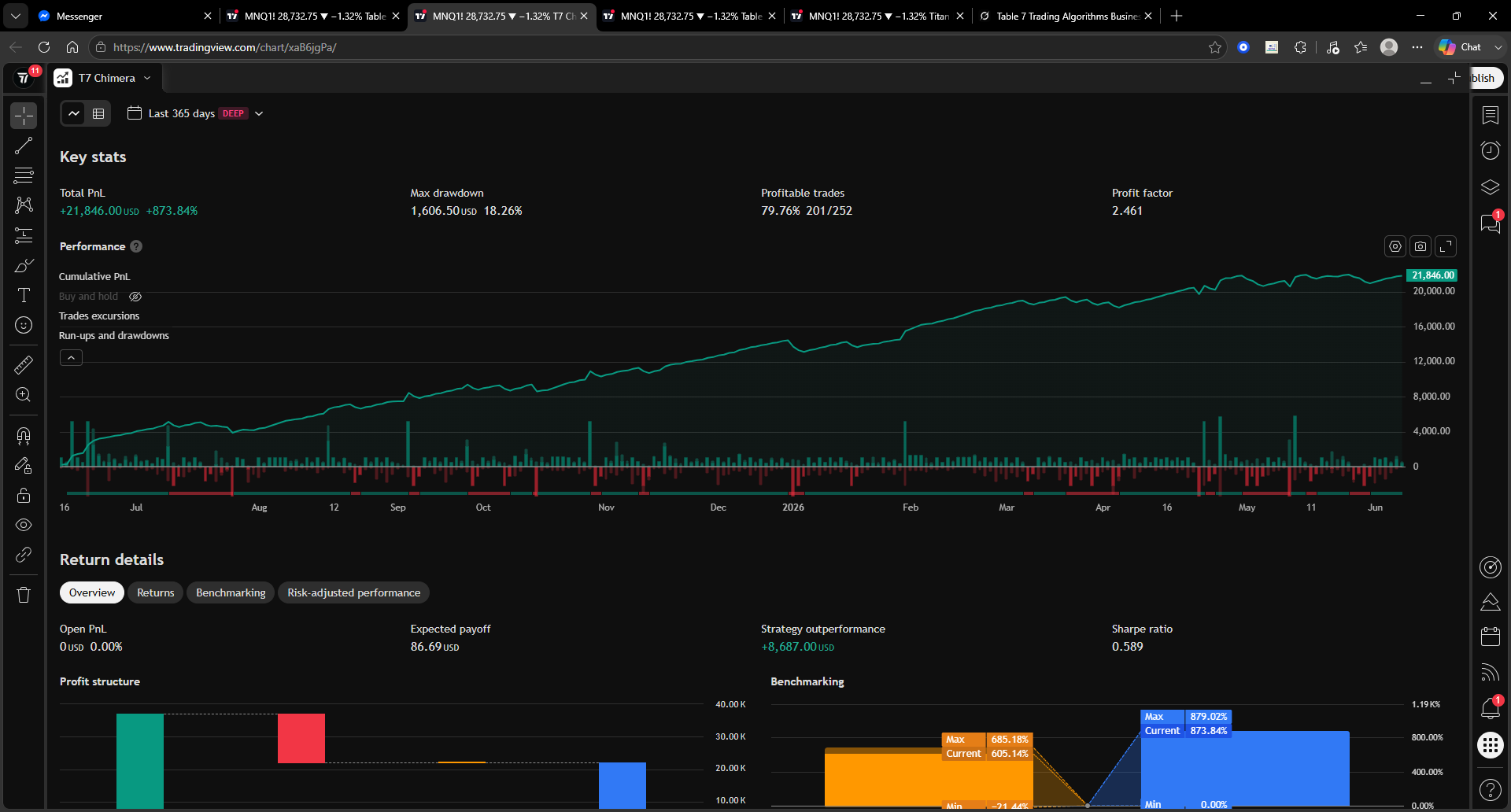
Flagship model
T7 Chimera
Built for futures traders who want structured entries, defined risk, and clean reporting.
Risk profile
$1,606.50 Max drawdown on Chimera (64% of $2.5K)Execution quality
79.76% Profitable trades, 201 of 252Testing window
365 days Backtests ending June 10, 2026Proof, not promises
Performance is shown with the uncomfortable numbers included.
Every featured system is paired with drawdown, profit factor, and win-rate context. If a model trips a realism warning, it does not get headline placement.
Past performance does not guarantee future results. All backtests, simulations, and historical reports are provided for transparency and should not be treated as promises of future returns.
Reporting basis
The Nasdaq systems above run on the NQ/MNQ chart, with performance measured on MNQ at the contract size listed on each card. The same signals run on NQ at roughly 10x the dollar value — about 10x the profit, drawdown, and required capital. Contract size is fully adjustable: raise it for more exposure or lower it to reduce risk. MNQ results use a cash account of roughly $2,500 to $3,500 in starting capital; NQ or larger size needs proportionally more, and on select systems sizing can be set to stay inside prop-firm drawdown and position limits. Max-drawdown figures show the worst peak-to-trough decline in dollars and as a share of that cash basis ($3,500 where the dollar drawdown exceeds $2,500).
Chimera
15m Flagship
15m flagship system with the strongest combined scorecard in the current deck, positive strategy outperformance, and controlled drawdown.
- Contract size3 contracts
- Total PnL (MNQ)+21,846 USD
- Total PnL (NQ)+218,460 USD
- Profit Factor2.461
- % Profitable79.76%
- Max Drawdown$1,606.50 (64% of $2.5K)
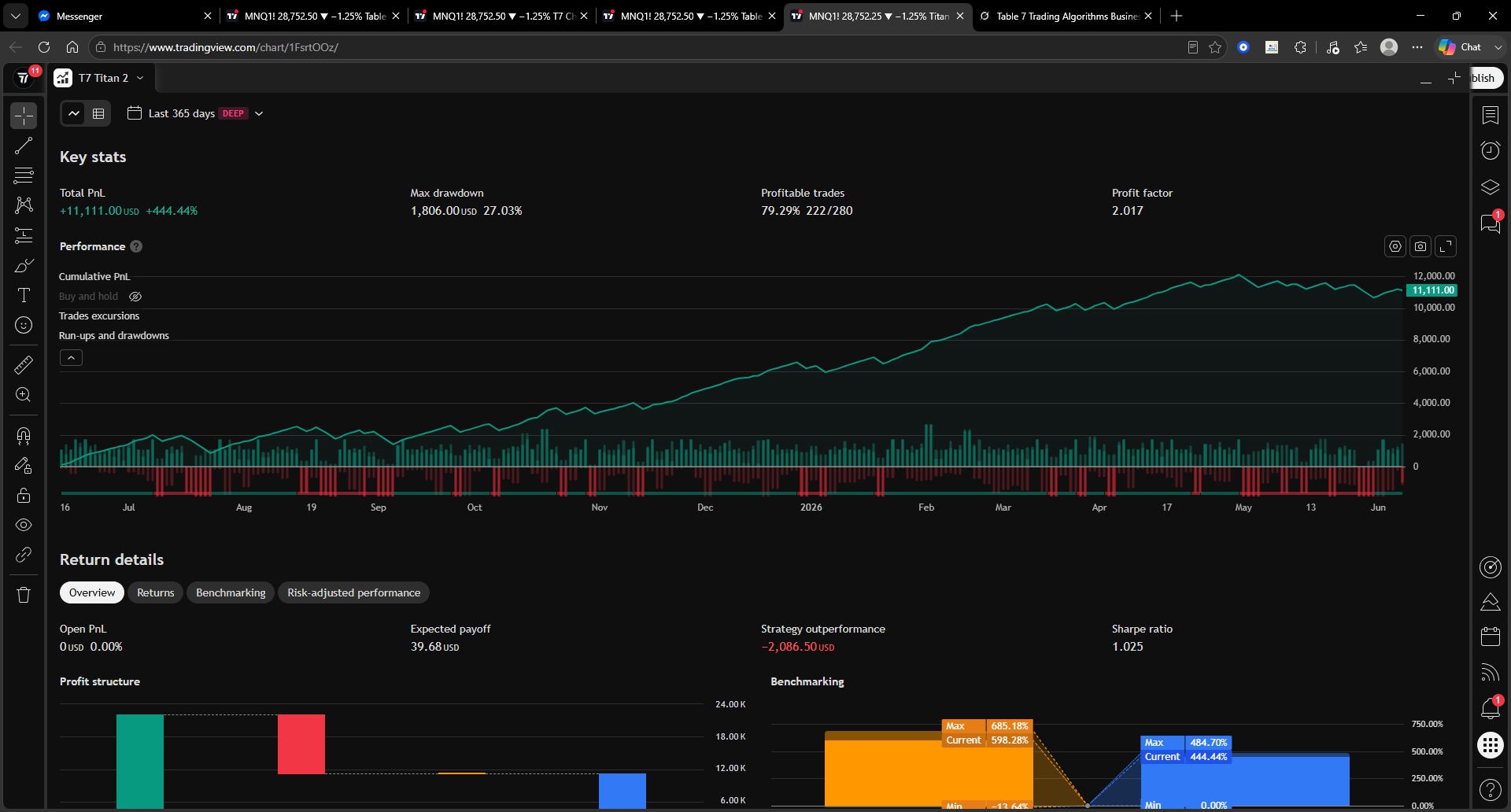
Titan 2
15m Core
15m balanced momentum system with strong profitability, durable win rate, and a cleaner Sharpe profile than the original Titan run.
- Contract size2 contracts
- Total PnL (MNQ)+11,111 USD
- Total PnL (NQ)+111,110 USD
- Profit Factor2.017
- % Profitable79.29%
- Max Drawdown$1,806.00 (72% of $2.5K)
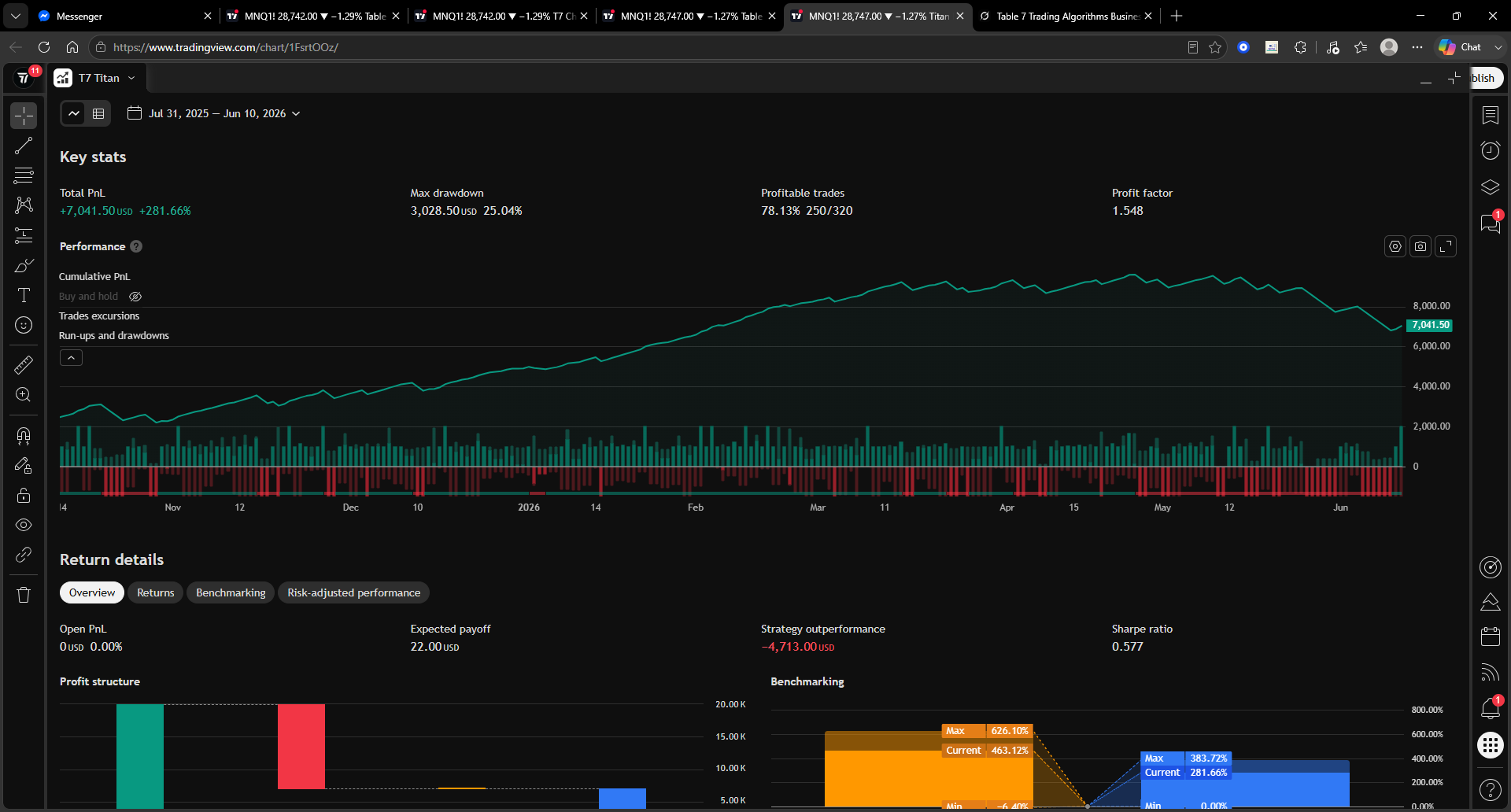
Titan
15m Core
15m foundational model with broader trade count, steadier progression, and a simpler entry profile before moving into Chimera.
- Contract size2 contracts
- Total PnL (MNQ)+7,041.50 USD
- Total PnL (NQ)+70,415 USD
- Profit Factor1.548
- % Profitable78.13%
- Max Drawdown$3,028.50 (87% of $3.5K)
Atlas
5m Core
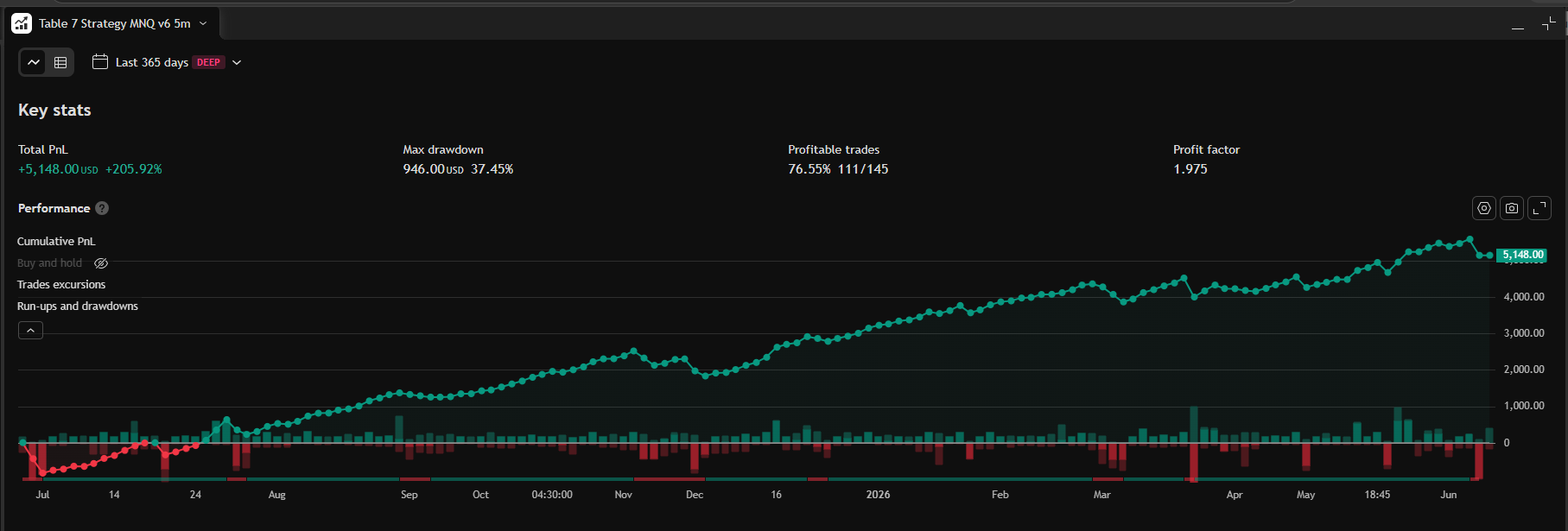
MNQ 5m chart model built for traders who want a cleaner structural read, steadier progression, and a direct way to track performance in context.
- Contract size4 contracts
- Total PnL (MNQ)+5,148 USD
- Total PnL (NQ)+51,480 USD
- Profit Factor1.975
- % Profitable76.55%
- Max Drawdown$946.00 (38% of $2.5K)
Scalper
1m Flagship
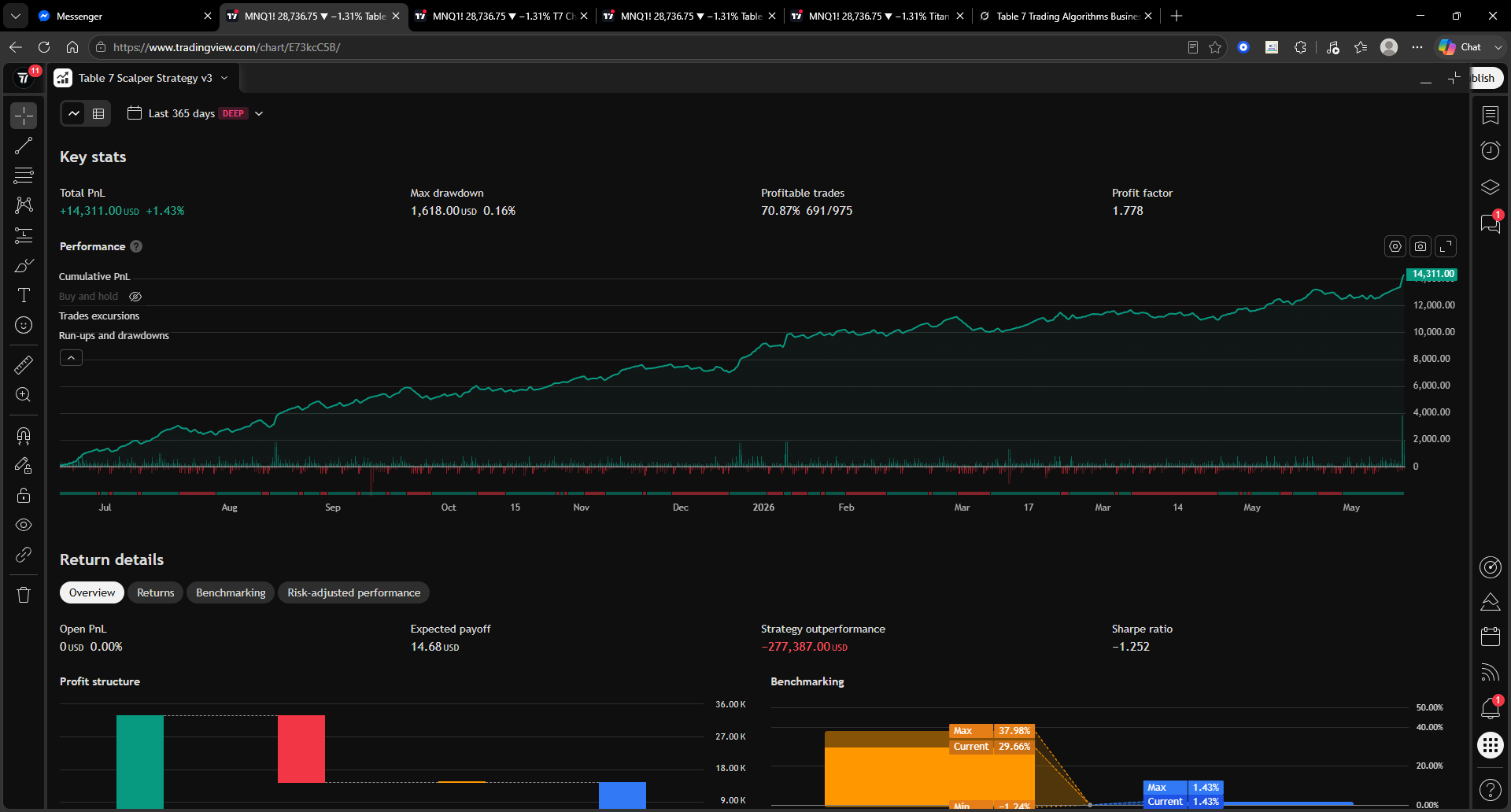
A 1m high-throughput system that trades the session's statistically strongest time windows. At each window, the T7 ML model calls the direction — long, short, or stand aside — taking many small, defined-risk trades instead of forcing entries all session.
- Contract size5 contracts
- Total PnL (MNQ)+13,863.50 USD
- Total PnL (NQ)+138,635 USD
- Profit Factor1.723
- % Profitable69.98%
- Max Drawdown$1,618.00 (65% of $2.5K)
Hydra Series
The Hydra engine, beyond Nasdaq — on Bitcoin and the S&P.
Same evening-reopen and opening-range structure, tuned per instrument — now on Micro Bitcoin (MBT) and Micro S&P 500 (MES), 15m. Entry parity is TradingView-validated, with NinjaTrader builds available. Shown on a $2,500 cash account at 3 micros per trade (2 at TP1 + 1 runner).
MBT Hydra
Bitcoin 15m
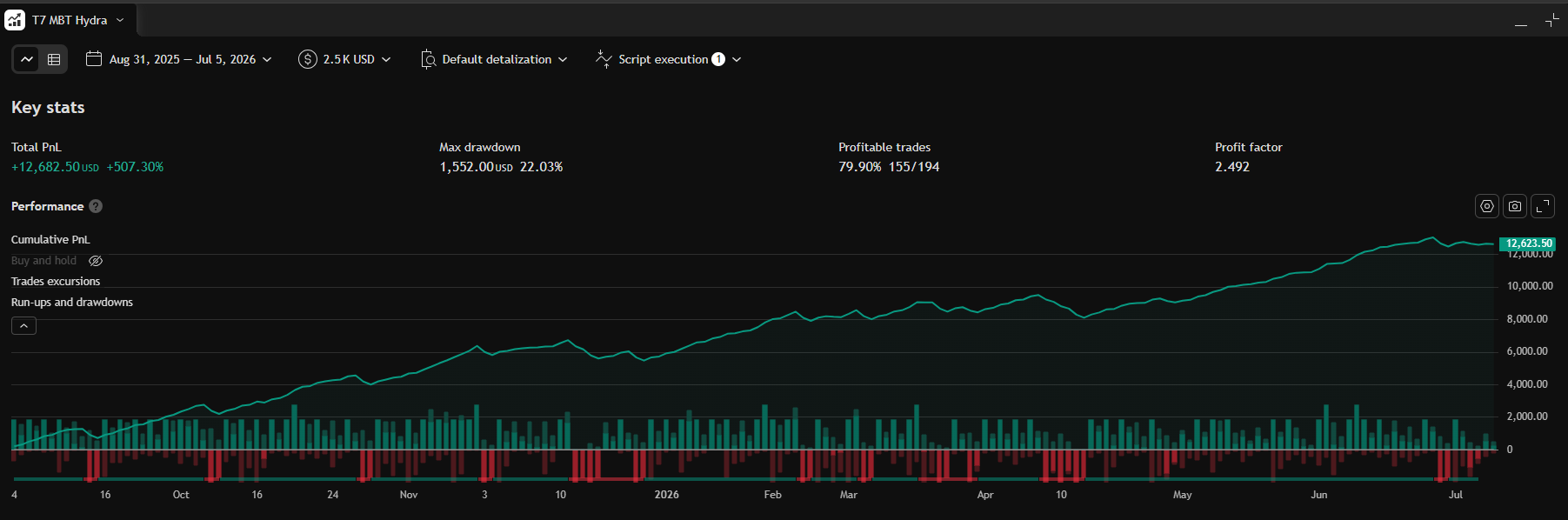
The Hydra engine on Micro Bitcoin — Globex-reopen and opening-range breaks with squeeze-state filtering and a TP1/runner scale-out.
- Contract size3 micros
- Total PnL+12,682.50 USD
- Profit Factor2.492
- % Profitable79.90%
- Max Drawdown$1,552.00 (62% of $2.5K)
MBT Hydra 2
Bitcoin 15m
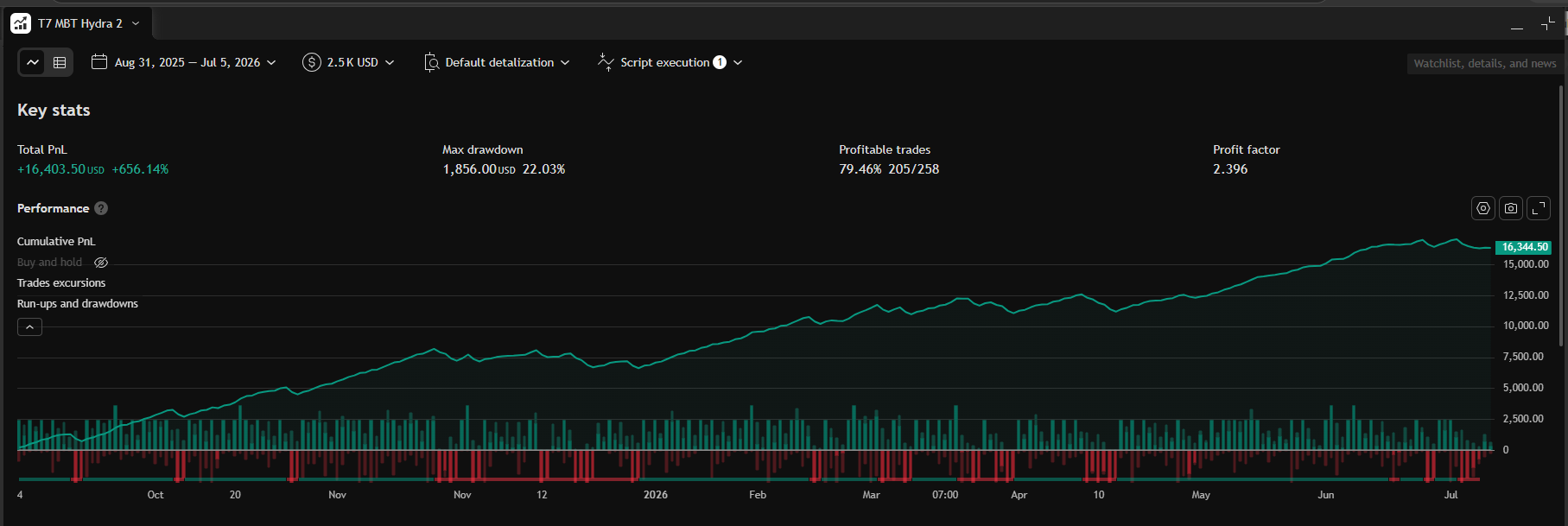
The expanded Hydra roster on Micro Bitcoin — additional tuned entries layered on top of the core engines.
- Contract size3 micros
- Total PnL+16,403.50 USD
- Profit Factor2.396
- % Profitable79.46%
- Max Drawdown$1,856.00 (74% of $2.5K)
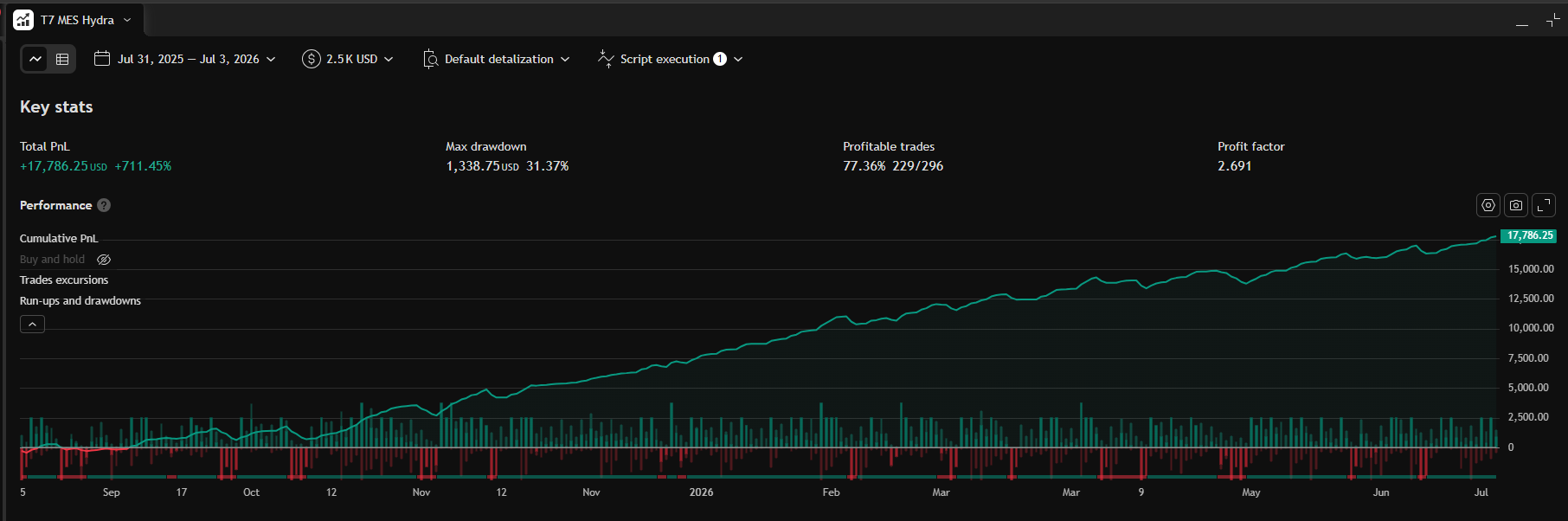
MES Hydra
S&P 15m
The Hydra engine on Micro S&P 500 — evening-reopen and opening-range breaks, squeeze-state routing, and TP1/runner exits.
- Contract size3 micros
- Total PnL+17,786.25 USD
- Profit Factor2.691
- % Profitable77.36%
- Max Drawdown$1,338.75 (54% of $2.5K)
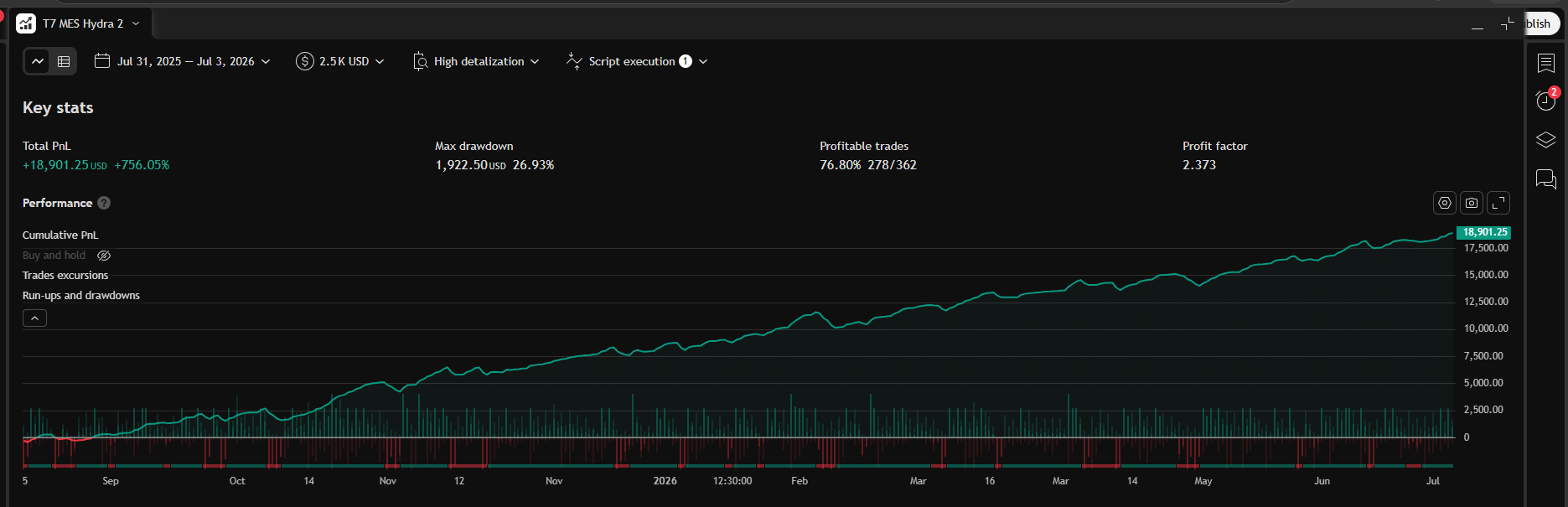
MES Hydra 2
S&P 15m
The expanded Hydra roster on Micro S&P 500 — extra filtered entries on top of the core engines.
- Contract size3 micros
- Total PnL+18,901.25 USD
- Profit Factor2.373
- % Profitable76.80%
- Max Drawdown$1,922.50 (77% of $2.5K)
Recent-regime note. The Hydra series is newer, and the results above cover roughly the last year. Extended back to 2023–24 these engines were weaker to negative — the edge shown is concentrated in the current market regime. Entry parity is TradingView-validated (implementation fidelity), but treat Hydra as newer, regime-sensitive systems rather than multi-year-proven, and size accordingly.
System stack
Designed to feel more like a quant desk than a signal Telegram.
The offer centers on a small number of differentiated models, each with a clear role in the stack.
Chimera
15m flagship multi-condition system with the strongest return-to-drawdown profile in the current set.
TradingView
NQ/MNQ 15m
NinjaTrader
Flagship
Titan 2
15m refined Titan branch with improved quality metrics and cleaner balance between upside and trade frequency.
TradingView
NinjaTrader
NQ/MNQ 15m
Momentum
Core
Titan
15m foundational trend model for traders who want a simpler entry engine before moving into more layered logic.
TradingView
NinjaTrader
NQ/MNQ 15m
Trend
Core
Atlas
MNQ 5m chart model focused on structural clarity, smoother progression, and a direct visual read on what the market is doing.
TradingView
NQ/MNQ 5m
Core
Scalper 4 and Scalper 5
1m high-throughput system that trades a fixed, optimized set of session time slots, with a machine-learning model calling the direction — long, short, or stand aside — at each window.
TradingView
NinjaTrader
NQ/MNQ 1m
ML-Driven
Fixed Time Slots
High Throughput
Flagship
MBT Hydra
New
The Hydra engine on Micro Bitcoin — evening-reopen and opening-range breaks with squeeze-state filtering and a TP1/runner scale-out.
TradingView
NinjaTrader
Bitcoin 15m
Reopen Break
MBT Hydra 2
New
The expanded Hydra roster on Micro Bitcoin — additional tuned entries layered on the core engines.
TradingView
NinjaTrader
Bitcoin 15m
Expanded
MES Hydra
New
The Hydra engine on Micro S&P 500 — evening-reopen and opening-range breaks with squeeze-state routing.
TradingView
NinjaTrader
S&P 15m
Reopen Break
MES Hydra 2
New
The expanded Hydra roster on Micro S&P 500 — extra filtered entries on the core engines.
TradingView
NinjaTrader
S&P 15m
Expanded
Using the Suite
No single edge fits every market — so you run the ones that do.
The lineup isn't redundancy, it's coverage. Markets rotate through trend, chop, and different volatility regimes, and each T7 system is built for a different one. Run the full set and let them average out, or actively lean into the ones in form — either way, the dated PnL in TradingView tells you what's working.
Different engines for different tape
Each system is tuned for a different rhythm — momentum and trend days, structured breakouts, fast intraday rotation. No single model wins in every condition, so the suite gives you several edges to deploy instead of forcing one strategy onto a market that doesn't suit it.
Read the PnL, pause when it rolls over
Treat each system's equity curve like any other chart. While it's trending up, it's in sync with the market. If the trend shifts down, pause that system until the curve turns back up — or until we push an update — then re-engage. Lean toward what's working now and ease off what isn't.
Run it active or steady
Either size to the conditions — heavier on the systems in form, lighter when the tape is unclear — or simply run them all at a default or preferred risk for your capital and let the edges average out over time. Contract size is your main risk dial, so set it to a level you can hold through the normal ups and downs.
Atlas Focus
T7 Atlas gives the MNQ 5m chart its own clean, visible lane.
Atlas is positioned for traders who want a more chart-centric 5m way to follow structure, trend development, and performance without losing the discipline of measured stats.
Read structure clearly
Atlas is meant to give the MNQ 5m chart a cleaner, more immediate visual read without burying the trader in noise.
Track context, not just entries
It is positioned for traders who want a chart they can actually follow, with trend development and trade context staying visible.
Expand the visual layer
This section is ready for more live chart imagery as the Atlas presentation library grows beyond the current performance snapshot.
Scalper Edge
T7 Scalper trades proven time windows — and a machine-learning model calls every entry.
The 1m T7 Scalper only fires in the session's historically strongest windows, and at each one the T7 ML model decides the move: long, short, or stand aside. Many small, defined-risk trades — each one classified live, not forced.
Trade only the strong windows
It sits out the dead parts of the session and concentrates on the time slots that have historically produced, rather than trading every minute.
Machine learning calls the direction
The windows are fixed, but the direction isn't hard-coded. At each one the T7 ML model reads the live market and votes long, short, or no trade.
High throughput, defined risk
Many small trades across the day, each with a fixed risk profile, so the edge comes from a high count of good setups instead of a few big swings.
The T7 ML model
Every entry is called by a Lorentzian k-nearest-neighbors classifier. At each window it snapshots the live market, compares it against a library of thousands of past setups, finds the closest historical matches, and votes long, short, or stand aside based on what happened next. The "Lorentzian" distance metric — the same geometry Einstein used to describe spacetime — reshapes how similarity is measured, so the model locks onto the current regime and shrugs off the spikes and outliers that fool ordinary indicators.
Tools & Indicators
Beyond the strategies: signals and utilities for hands-on traders.
Not every trader wants full automation. These put the T7 edge directly on your TradingView charts.
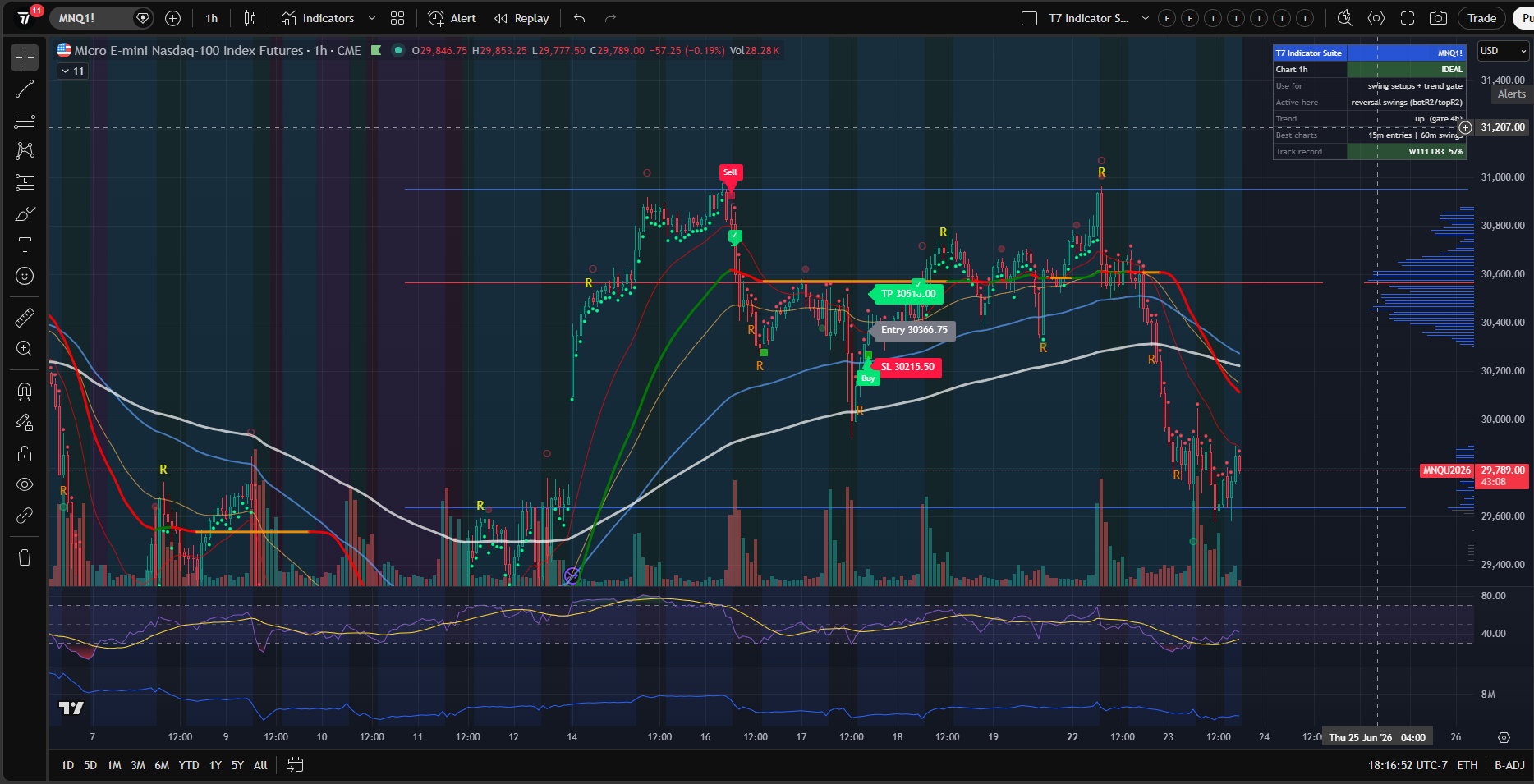
Indicator Suite
New
Graded long and short setup signals with built-in entry, stop, and target levels and a higher-timeframe trend filter, printed right on your TradingView charts. Runs on any futures market and any timeframe — trade the T7 logic by hand, separate from the automated strategies.
TradingView
Long & Short Signals
Any Futures Market
Manual / Discretionary
Indicators
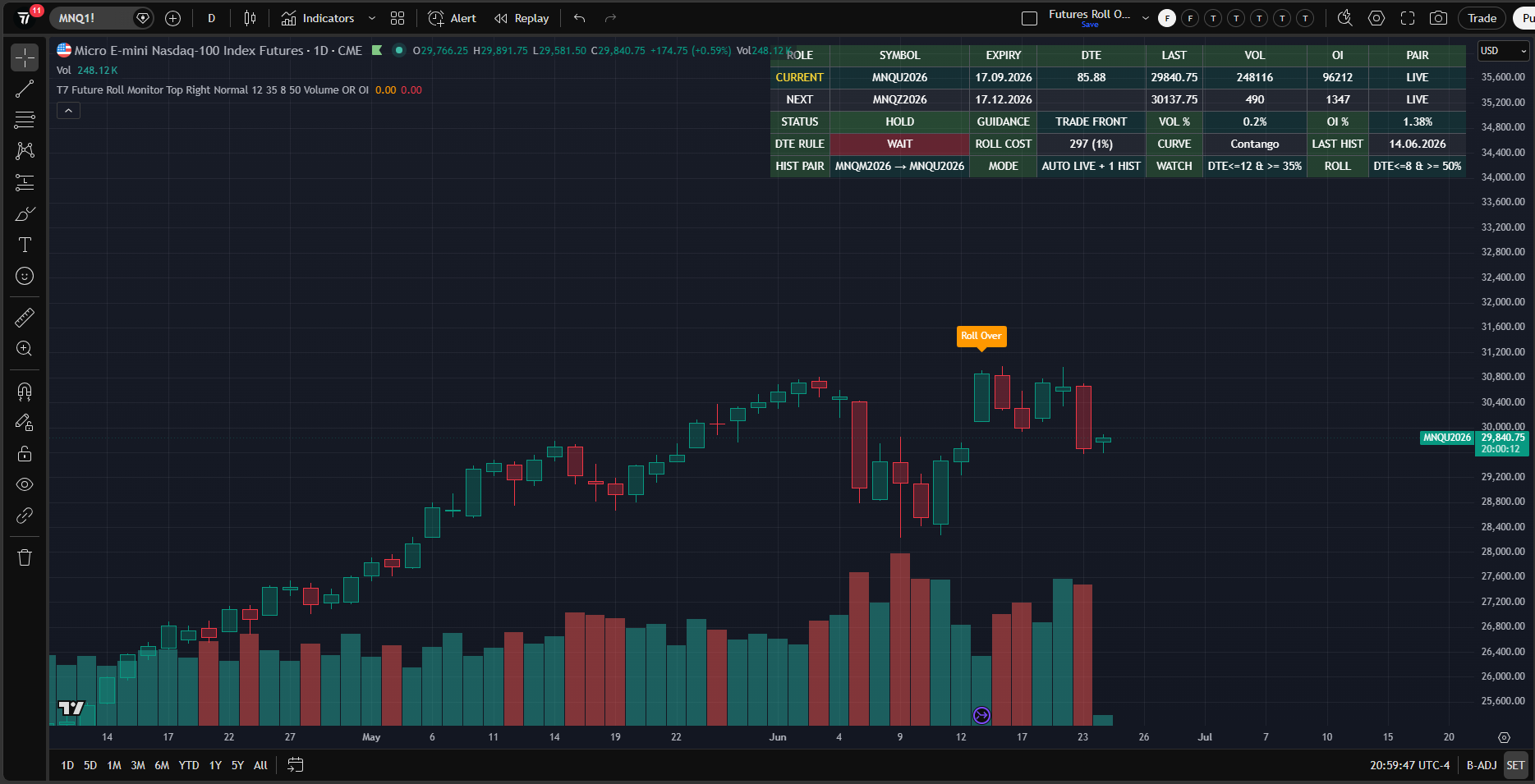
Futures Rollover Monitor
New
Stop guessing when to roll. A clean TradingView monitor that flags the contract rollover window, so you are always trading the right front-month into every quarterly expiration.
TradingView
Futures
Rollover Timing
Utility
Newest Builds
Our latest releases.
The Hydra series (Bitcoin & S&P) is live — see the Hydra Series section for dated performance. The five-slot Scalper is live and Chimera 2 is in testing, with their dated numbers to follow.
Scalper 5-Slot
New
The newest Scalper build — it adds a fifth time slot that has been performing strongly lately to the proven four-slot original. Same T7 ML engine, one more window per session.
TradingView
NinjaTrader
NQ/MNQ 1m
ML-Driven
5 Time Slots
High Throughput
Chimera 2
In Testing
A DCA build of the flagship Chimera: it adds to the position on pullbacks before targets are hit, improving the average entry on trades that dip on the way to TP. Up and running now, still in testing.
TradingView
NinjaTrader
NQ/MNQ 15m
DCA
MBT Hydra
New
Hydra on Micro Bitcoin, 15m — live, with dated performance in the Hydra Series section above.
TradingView
NinjaTrader
Bitcoin 15m
MBT Hydra 2
New
Expanded Hydra on Micro Bitcoin, 15m — live; full stats in the Hydra Series section.
TradingView
NinjaTrader
Bitcoin 15m
MES Hydra
New
Hydra on Micro S&P 500, 15m — live, with dated performance in the Hydra Series section above.
TradingView
NinjaTrader
S&P 15m
MES Hydra 2
New
Expanded Hydra on Micro S&P 500, 15m — live; full stats in the Hydra Series section.
TradingView
NinjaTrader
S&P 15m
Aggression Tiers
Numbered to match the market — aggressive when it's hot, conservative when it's rough.
The number is a risk dial. Lower numbers run more aggressively for hot, trending markets; each step up filters harder and trades more selectively as conditions get rough. When the tape turns difficult, move up a number. Titan 3 and 4 and Chimera 3 and 4 extend that ladder for the toughest markets.
Titan 3
Coming Soon
A more selective Titan — extra filters trim marginal setups for choppier, tougher tape.
TradingView
NinjaTrader
NQ/MNQ 15m
More Selective
Titan 4
Coming Soon
The most conservative Titan — heaviest filtering for the hardest markets; fewer trades, higher conviction.
TradingView
NinjaTrader
NQ/MNQ 15m
Most Conservative
Chimera 3
Coming Soon
A more selective Chimera — tighter filters that stand aside more often as conditions get rough.
TradingView
NinjaTrader
NQ/MNQ 15m
More Selective
Chimera 4
Coming Soon
The most conservative Chimera — maximum filtering for the toughest markets.
TradingView
NinjaTrader
NQ/MNQ 15m
Most Conservative
TV Scripts · Stocks Lane
Classical Charting — alerts and Social Desk on the TV scripts path.
Preliminary research is optimistic and still under validation — no live Classical capital record yet. Table 7 TV scripts are the umbrella: futures strategies and alerts, plus Classical Charting TV strategy/indicator alerts and the web-hosted T7 Social Desk (full flagged list) as that lane opens. NinjaTrader remains a separate delivery path for supported futures systems. Classical auto account-management is in paper testing and coming later as a separate add-on — not live subscriber access today.
Classical Charting
Included with TV scripts
A stock swing-trading system built on the Edwards & Magee playbook — rectangles, double and triple bottoms, ascending triangles, head-and-shoulders, flags and pennants. Daily charts, multi-week holds, with leftover cash hedging when the S&P sits below its 200-day average. TradingView alerts plus the web Social Desk are part of the Table 7 TV scripts story — not a separate Classical-only price.
Stocks
TV Alerts
Web Social Desk
Long + hedge overlay
~1,650-Name Target Universe
Explore Classical Charting → See Social Desk → TV scripts pricing →
Preliminary 32-year book at 5% planned loss, the research dashboard, T7 Social Desk (Forming / Confirmed / Ended / Skipped), compounding illustrations, and the fine print — still preliminary, still honest.
NinjaTrader & Classical auto
Separate / ComingNinjaTrader scripts for supported futures systems stay on their own delivery path — not what unlocks the Classical web desk. Classical auto account-management (TV-themed auto routing) is in paper testing and will be offered later as a separate or add-on fee, not as live subscriber access today.
NinjaTrader later/separate
Classical auto coming
Paper testing
How It Works
A clear path from interest to active access.
Choose a tier
Start with a focused TradingView package or move straight into the flagship stack.
Receive platform access
Subscribers receive TradingView access — including Classical alerts and web Social Desk as that lane opens — and, where applicable, separate NinjaTrader delivery for supported futures systems.
Operate with context
Each system is paired with dated proof, risk disclosure, and platform guidance instead of blind alerts.
Platform & time zones
NinjaTrader strategies run on Eastern Time (ET) chart times, so set your NinjaTrader chart to ET. TradingView handles it for you — the time logic auto-adjusts to whatever timezone your chart is on (PST, ET, CT, and so on), so entries fire at the right session times wherever you trade.
Multiple strategies & hedging
Running more than one automated NinjaTrader strategy on the same account can put you at risk of hedging — two systems holding opposite positions at once, or one system's exit closing another's trade. The cleanest prop-account rule is one automated strategy per symbol family per account. The TradingView versions are hand-traded, so you control every entry and exit and can keep two trades from conflicting on a single account.
Prop account helper
If you want to run multiple automated systems without creating avoidable hedging risk, split them by market family. In practice, that means choosing at most one NQ/MNQ strategy, one MBT strategy, and one MES strategy on the same automated prop account.
| Market family | Strategies in that lane | Same automated prop account? | Guidance |
|---|---|---|---|
| NQ / MNQ | Chimera, Chimera 2, Chimera 3, Chimera 4, Titan, Titan 2, Titan 3, Titan 4, Atlas, T7 Scalper, Scalper 5-Slot | One at a time | Choose one NQ/MNQ strategy per automated prop account. |
| MBT | MBT Hydra, MBT Hydra 2 | One at a time | Do not run both MBT Hydra branches on the same automated prop account. |
| MES | MES Hydra, MES Hydra 2 | One at a time | Do not run both MES Hydra branches on the same automated prop account. |
| Cross-market mix | One NQ/MNQ strategy + one MBT Hydra branch + one MES Hydra branch | Usually the cleanest mix | Different markets mean lower hedging risk, but still confirm your prop firm's multi-market automation rules. |
| TradingView manual use | Any combination you are entering and exiting yourself | User-controlled | Because you decide each order, you can avoid the automated conflicts prop firms usually dislike. |
Examples to keep separate on automated prop accounts: Chimera + Titan 2, Atlas + T7 Scalper, MBT Hydra + MBT Hydra 2, and MES Hydra + MES Hydra 2. Example of a cleaner mix: Chimera on NQ/MNQ, MBT Hydra on Bitcoin, and MES Hydra on the S&P. Use this as a practical routing guide, then confirm the exact wording of your prop firm's policy before going live.
The Math
What you pay vs. what these systems have historically produced.
Most futures algo desks charge a five-figure fee just to get in the door, then bill monthly on top. Table7 has no entry fee. Here is the historical math behind the subscription, with the uncomfortable parts left in.
The usual model
- To join$10,000-$12,000
- Then monthly$300-$400
- Year one$13,600-$16,800
Table7
- To join$0
- Then monthly$79-$249
- Year one (Full Table)$2,988
Lower price, not lower quality
The smaller price tag is not a sign of weaker systems. These go toe-to-toe with — and in many cases beat — the best retail algos available. The lower cost is the access model, not the quality: a fair monthly rate instead of a five-figure fee just to walk in the door.
Where your capital belongs
Paying $10,000 to $12,000 just to unlock a tool is a large chunk of capital that never gets to trade. We would rather you keep it and put it to work with the systems — fund a cash account, or buy a prop-firm evaluation and trade on their capital — than spend a small account's worth simply to get in the door. With no entry fee at Table7, every dollar you would have handed over for access stays available to actually trade.
| System | Size | Avg win / contract | Avg loss / contract | Trades / mo | Avg net / mo (hist.) |
|---|---|---|---|---|---|
| Chimera | 3 | $183 | -$293 | ~7 | ~$1,820 |
| Titan 2 | 2 | $99 | -$188 | ~12 | ~$925 |
| Atlas | 4 | $94 | -$155 | ~3 | ~$430 |
| Titan | 2 | $80 | -$184 | ~13 | ~$585 |
| Scalper | 5 | $47 | -$64 | ~17 | ~$1,155 |
| Full bundle | — | $503 sum | -$884 sum | ~52 | ~$4,835 |
All figures on MNQ at the contract sizes shown; NQ runs the same signals at roughly 10x the dollars, drawdown, and capital. Trades/mo is distinct signal entries: TradingView's tester logs each contract as a separate trade, so the raw counts in the screenshots run higher (Chimera's 252 is about 84 signals across 3 contracts). Average win and loss are shown per contract. These are high-win-rate systems — they win roughly 70-80% of the time, but the average loss runs larger than the average win, so the edge comes from winning often, and a cluster of losses in a bad stretch is what drives the drawdowns shown above. One average winning Chimera contract ($183) more than covers a full month of Flagship Core ($149).
Trading is not smooth income. Historical drawdowns ran roughly $950 to $3,000 — about 38% to 87% of the $2,500 to $3,500 cash basis — and individual months can be flat or negative. These systems have run successfully on funded prop accounts, including $50k accounts with $2,500 trailing and end-of-day drawdown limits; but in challenging market conditions a prop account can still hit its limit, so downsizing contracts during those stretches is the recommended way to manage risk. The monthly averages above are spread across winning and losing stretches, not a steady paycheck — they show what has historically played out, not a forecast or a guarantee.
Pricing
Table 7 TV scripts access.
Existing tiers below are the TV scripts path: futures strategies and alerts, with Classical Charting (TV strategy/indicator alerts + web Social Desk) included as that lane opens — no separate Classical price. NinjaTrader delivery remains on the tiers that already list it, as a separate path from the Classical web desk. Reach out for current access details.
Signal Desk
$79/mo
Best for traders who want one core model with a lower-friction start.
- Choose Titan 15m, Titan 2 15m, or Atlas 5m
- TradingView access
- Release notes and platform guide
- Classical Charting alerts + Social Desk included as that lane opens
Flagship Core
$149/mo
Both flagship systems, with deeper coverage and platform flexibility.
- T7 Chimera 15m and T7 Scalper 1m — both flagships
- TradingView and supported NinjaTrader delivery
- Priority onboarding
- Classical Charting alerts + Social Desk included as that lane opens
Full Table
$249/mo
For advanced users who want the broadest release set and early access to new branches.
- Chimera 15m, Titan 15m, Titan 2 15m, Atlas 5m, and T7 Scalper 1m
- Research notes when new models graduate
- Priority access to new updates
- Classical Charting alerts + Social Desk included as that lane opens
Get Started
Talk with Table7.ai about the right stack for your workflow.
Whether you want a focused TradingView package or broader access across the lineup, use the contact path below to start the conversation.
Contact List